
Any site specific information that you are provided is strictly confidential. You must not communicate the information provided to anyone other than the clients' authorised representatives, Leisuresec's authorised representatives and Leisuresec Security Operatives. Breach of confidentiality, whether intentional or not, can have serious implications both to the Company, the client and the Security Operatives. Any breach should be reported immediately.
Contacts
Head Office Tel: 0844 282 4300 │ Email: office@leisuresec.co.uk
Control Room Tel: 0345 218 4300 │ Mobile: 07426 393239 │ Email: controlroom@leisuresec.co.uk
REGIONAL MANAGERS
Mark Watkins (National) Mobile: 07815 147042 │ Email: mark.watkins@leisuresec.co.uk
Peter Green (South) Mobile: 07831 585814 │ Email: peter@clearwaterpeople.com
Suraj Kang (North) Mobile: 07943 669083 │ Email: suraj_kang97@hotmail.co.uk
IMPORTANT INFORMATION:
Vetting to office@leisuresec.co.uk
Time sheets must be sent to wages@leisuresec.co.uk by Tuesday 12:00.
Client premises inductions:
https://www.leisuresec.org/security-operative/client-premises-induction
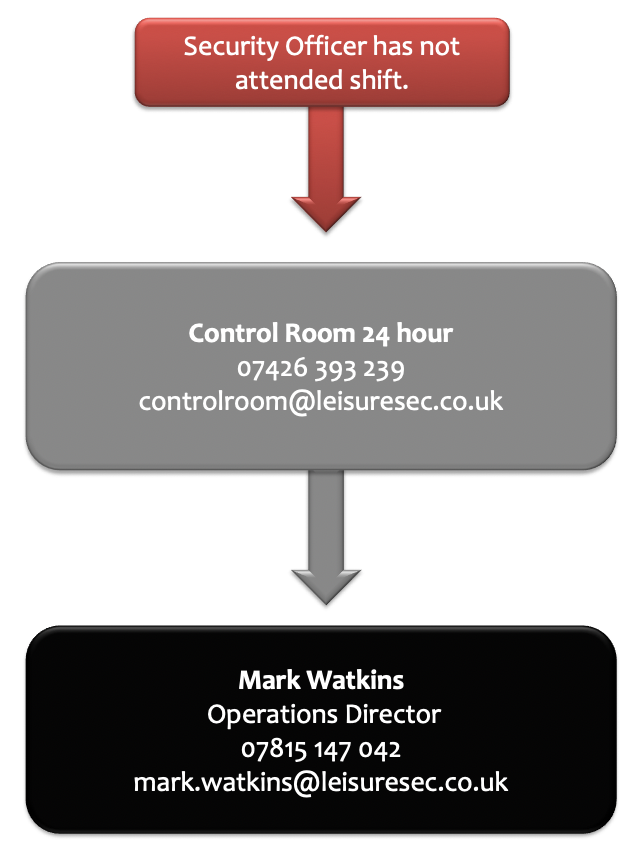
Shift Cover Procedure
If you or a another security guard cannot/has not attended a shift, please following the below procedure.
Code of Conduct for SIA Licence Holders and Applicants
Act with honesty and integrity Be trustworthy Protect the people and property you are entrusted to protectBe professional at work Act with fairness and impartiality at work Be accountable for your decisions and actionsLeisuresec Mission Statement
The Directors, Managers and Stakeholders within Leisuresec promise that we will:
- Create and maintain a secure and safe environment for our clients and their assets.
- Continually review how we deliver our service in order to operate at optimum levels.
- Operate fairly, profitably and ethically in all our dealings with customers, suppliers, and work force.
- Listen to our clients needs and respond to every request within 24 hours.
- Minimise our carbon footprint by using the very best local resources wherever possible
- Motivate our workforce to excel in their duties.
- Train nurture and inspire our work force to exceed client expectations.
- Operate transparently to show clients how we achieve our results.
- Apply tried and tested systems to objectively audit our service delivery and where improved systems are available we will incorporate them into our processes.
- Continually research and embrace new technology to improve communication and service delivery.
- Provide our customers with one phone call access to decision makers and to deliver results.
- Treat the trust our customers have placed in us with the respect it deserves and deliver a service to be proud of.

| JOB TITLE: | Security Operative |
|---|---|
| RESPONSIBLE TO: | Operations Manager |
| SUBORDINATES OF: | Area Manager |
| RESPONSIBLE FOR: |
Keeping the site safe and secure, preventing theft and/or damage, portraying the company image and ethos at all times
|
| BEFORE COMMENCING DUTIES: | Complete the Induction Training process using the Assignment Information. |
Understand the Conditions of Your SIA Licence

Published By: Get Licensed
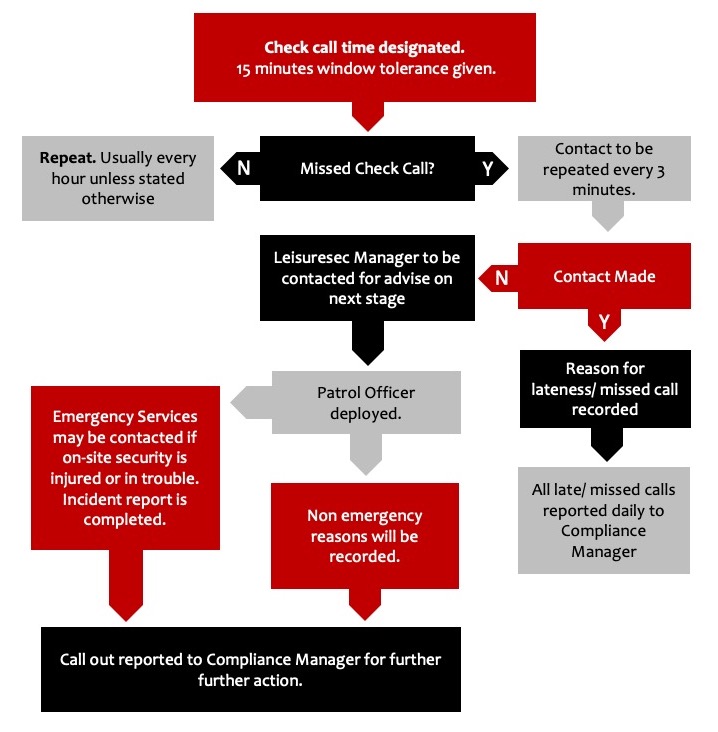
Check Call Process
Risk Assessment
This Risk Assessment is a general evaluation of the hazards that could occur at a site. Some of the areas included will not be relevant to all sites, for example lone working.
Site specific details should be included when you complete your induction. Sites will also have their own policies and procedures in place for Health & Safety, Emergencies, etc.
| POTENTIAL HAZARDS | CONTROL MEASURES |
|---|---|
| Vehicle related accidents |
Observe site regulations & signage. Warning signage usually used where pedestrians may be in close proximity to moving vehicles. Remain vigilant at all times when moving in the vicinity of vehicles. All persons should use footpaths and designated walkways.All persons should wear PPE including hi vis. Security guards have first aid training as part of the licence requirements. Raise any concerns to management |
| Lone Working |
Control room conduct hourly welfare check calls. Emergency procedures in place to respond to lack of regular contact with guards Avoiding confrontation where possible is recommended, however, security guards are trained in conflict management as part of their SIA licencing training. Hi-Vis are provided to be increase visibility Avoid poorly lit areas where possible and torches should be used in poorly lit areas. |
| Slips and Trips |
Wearing the correct PPE (i.e. work boots) can help prevent slips/trips. Poor levels of internal & external lighting around site should be raised as a concern. Aim to keep good standards of housekeeping around site. Reporting any hazards to management can prevent an accident from happening. Designated patrol routes are usually provided to security guards to follow. Try to avoid walking on grass verges during patrols. Absorbent matting used at external doorways to reduce risk of wet floors during inclement weather. |
| Manual Handling | Good practise to avoid manual handling of heavy or large items. |
| Electrical |
PAT testing regime should be in place. Good practise to identify and report any damaged electrical outlets, cables and connections. Most sites will request not bringing personal electrical equipment onto the site. Any defective equipment should be promptly taken out of use and replaced. |
| Fire |
Most sites covered by fire detection & alarm systems. Most sites have appropriate portable fire fighting equipment. Most sites will have their own emergency procedures to follow. Emergency exits kept clear of obstructions. Fire safety awareness and training are part of the SIA licencing requirements. Some sites will offer regular fire safety training |
| Other Emergencies |
Each site will have their own policies and procedures in place to follow. First Aid and Terrorism Awareness is part of SIA licensing requirements, security guards should use their training in an emergency |
| Violence |
All incidents to be logged and passed on to Leisuresec management ASAP. Staff to utilise mobile phone for communication. Trespassers shouldn't be challenged if guards are at risk of violence. Police to be notified in the case of a serious offence such as violence, drugs etc. Using their training, the securty guard usually determines whether the offence is serious enough to inform the authorities or whether it can be dealt with internally. Conflict resolution is part of the SIA licening requirements Guidance from the Leisuresec security manager can be provided |
| Display screen equipment | Staff able to take regular breaks. |
| Working at Heights |
General policy of no work conducted at height. Avoid high level shelving. |
Additional Risk Control Information:
- CCTV may be in operation at some sites and usually covers the main areas, however, some areas might not be covered
- Most Leisuresec sites have a direct contact to police camera control
- All sites can be supplied with Body Cameras but to adhere to strict GDPR procedures
- All sites have access to Radios
SIA Standards of Behaviour
Published By: Night Time Industry Association
What are the SIA Standards of Behaviour?
The Security Industry Authority (SIA) is the body responsible for licensing individuals working within the Private Security Industry, including security guards. The SIA has set out standards of behaviour that they expect security operatives to follow. The aim of the Standards of Behaviour is to set, raise and maintain national standards of behaviour for security operatives and set out the rules that security operatives should always follow.
The authority of security guards to carry out their duties comes from the premises licence holder, or the premises management acting on behalf of the premises licence holder, and they can ask security guards to follow additional rules. However these additional rules should never conflict with the SIA standards.
What do the SIA Standards of Behaviour cover?
The Standards of Behaviour cover the following main areas:
Personal appearance
Security Operatives should always:
- wear smart, presentable clothes that show clearly that they are a security operative. Clothing must also meet the client's guidelines
- wear their SIA licence on the outside of their clothing, with the photograph displayed, at all times while on duty.
Professional attitude and skills
Security Operative should always:
- treat people in the same way as they would like to be treated
- greet visitors in a friendly and polite manner
- act fairly and not discriminate on the grounds of gender, sexual orientation, ethnicity, disability, marital status or any other difference in individuals which is not relevant to the door supervisors’ responsibility
- carry out their duties in a professional and courteous manner with due regard and consideration to others
- behave with personal integrity and understanding
- use moderate language, which is not defamatory or abusive, when dealing with members of the public and colleagues
- be fit for work and remain alert at all times
- develop appropriate knowledge of local services and amenities.
General conduct
Security Operatives should:
- never solicit or accept any bribe or other consideration from any person
- not drink alcohol or be under the influence of alcohol or drugs whilst on duty
- not display preferential treatment towards individuals
- never abuse their position of authority
- never carry any item which is or could be considered threatening
- report all incidents to the management
- co-operate fully with members of the police, local authority, SIA and other statutory agencies such as Trading Standards and HM Revenue and Customs, who have an interest in licensed premises and the way they are run.
Security Guard Duties and Responsibilities
Published By: Close Career and Off Duty Officers
Although the Security guard duties and responsibilities depend on the client’s needs, the primary duty of the security personnel is prevention and deterrence of the crime and enforcing the rule and regulations where they are guarding; protecting the people, property and information.
1. Protection of People
Security guards are responsible for the safety and well being of anyone who may interact with the site.
Who are protected by security guards?
- The client and his staff
- Public: people who use the client’s property
- Government officials
- VIP’s
How does the security guard protect people?
- Observation of crime against a person.
- Keeping the people out of danger hazards areas.
- Being alert to the dangerous situation of hazards.
- Ensuring a safe environment.
2. Protection of property
Security guards are responsible for protecting property from stealing or damaging by someone.
What kinds of properties do security guards protect?
- Client property (Building and contents)
- Personal property (property of clients/Employees/customers)
- Store & merchandise
- Public property (Parks/Roads/government Building
Tools used to protect properties.
- Barriers
- Surveillance Equipment (CCTV)
- Your observation power (Eyes)
- Awareness of your surrounding
- Patrol
- Searches
- Crowd control
- Alarm
- Locks
Patrolling around the site deters theft, robbery, and vandalism. Property damage happens in many ways such as fire can completely damage the building and property, water leakage, flood, melting snow, and frozen pipe. If you see them while they are small and be able to report them in time it prevents property damage.
3. Protection of Information
Protection of information is becoming a more crucial part of the security job all the time. Stealing intellectual property and cybercrime is increasing even though most companies and governmental institutes have fought against this. Security guards protect the information as follows:
- Confidentiality- As a security guard, you know privileged information such as access and egress routes of the company and how they can be accessed, i.e. keys and access codes. You should not allow anyone to use the key and access card if they are not authorised to do so. If the camera and alarm system are under repair or not working you should keep this between those permitted to know. A big part of protecting information is knowing when it is “okay” to talk and when not “okay” to talk.
- Computer crime- Nowadays most of the business data is stored on computers and many wifi enabled devices are used to access and use the data, however, people can steal/access and this data or devices for goods, and services and sell for profit, financial records can be used to access accounts or credit cards, and data can be withheld for ransom.
To achieve these objectives, your duties and responsibilities may include:
1. Be a visible deterrent to crime.
Criminals are far less likely to perpetrate a crime such as theft, vandalism or a physical assault when there is a security guard present. The mere presence of security personnel will stop would-be burglars, muggers and shoplifters from attempting to cause harm to people or property.
2. Identifying suspicious behaviour.
Businesses benefit greatly from having a dedicated team keeping watch and identifying irregular and suspicious behavior. Business owners cannot expect their employees to have the skills to identify when something isn’t right. Security guards have the training and expertise to identify when there is a smell, sound or sight that is abnormal and needs attention.
3. Contacting and communicating with the authorities.
In the unfortunate event of an emergency situation, security guards act as a knowledgeable resource and point of contact for the authorities. Security guards are trained to observe and gather the information that fire or law enforcement authorities need to do their jobs. Security guards act as partners with business owners, police and fire services.
4. Monitoring access to properties.
One of the most prevalent threats for businesses is unauthorised access to a property. Hospitals, construction sites, schools and other high-profile organizations understand the need for vigilant monitoring of their entrances and exits. Security guards can check credentials and maintain logs of visitors, vendors and employees.
5. Taking action in emergency situations.
Security guards have the skills and training to respond to any emergency as it arises. As a dedicated watchful eye, security personnel are often the first to know about a security situation and the first to act. They are able to assist in evacuations and other serious security events.
Uniform

Standard Industry Requirements:
Black SuitWhite ShirtsHi Vis JacketsBlack TrousersBlack TiesSafety Boots
Whilst on duty, unless otherwise instructed by management, it is a legal requirement for security operatives to display their SIA licence at all times, usually by wearing a high-visibility arm band.
Before your shift...
- Before the start of your first shift you will given a tour of the premises and the procedures as an induction. You can complete your induction here.
- A risk assessment has been completed for the premises and consulting it before commencing a task will ensure you are aware of any changes to the role and the associated risks.
- There will be a signing-in book to log each of your shifts. Please record precise information as erroneous entries may delay payment of your fees.
Access and Egress Control
Published By: BIIAB
The Purpose of Access and Egress Control
Access and Egress Control means that there is a system in operation that controls who or what can enter or leave a site lawfully. The access control system used will depend on the site’s location and the perceived risks associated with that site. Professionally controlled access and egress will enable all concerned parties, including security, management, health and safety, and the emergency services, to have an accurate record of who is on and off site at any given time.
Unrestricted access or un-enforced access control provides those with criminal intent the opportunity to gain access to unauthorised areas. If the opportunity is provided they will take it! Maintaining control of the access and egress to premises reduces the risk of criminal or dangerous acts occurring on those premises.
Access and egress control is one of the primary and most highly profiled duties of a security officer. The security officer will need to be able to deal with the general public and operate various methods of controlling site access and egress to enable authorised access and egress and prevent unauthorised access and egress.
To meet this requirement the security officer needs to know who is and who is not authorised. This information will be in the site’s assignment instructions. The security officer must familiarise themselves with this information before taking on the responsibilities associated with enforcing access and egress control.
Access and egress control will apply to the following:
- Current employees
- Notified visitors
- Authorised contractors
- Authorised cleaners
- Notified/authorised couriers
-
Representatives from statutory agencies.
All of the above will report to the premises’ entry points and will be reliant on the duty security officer and/or the security entry systems to allow them access and egress. However, there are other people who may attempt to gain unauthorised access or egress. Security officers must be constantly aware of this potential. They must do all they can to deter, detect and report such activity. People attempting to gain unauthorised access will possibly include the following:
- People with criminal intent
- Ex-employees who may demonstrate animosity or be bared from entering due to their previous actions. This may pose a particular problem if the ex-employee now has a job that would usually allow site entry; i.e. delivery driver
- Angry neighbours or persons disgruntled with the company or one of its employees
- Vagrants
-
TV and newspaper reporters.
It is important that when carrying out their duties and dealing with the general public the security officer must be professional, courteous, and mindful of their health and safety at all times.
Unauthorised Access
For access control to be effective the security officer must be able to detect unauthorised access. The security officer should be observant and suspicious at all times and be aware of the following indicators:
Physical:
- Activated security alarms
- Broken or open windows
- Damaged or open doors
- Ladders or other climbing equipment left unattended
- Noises
- CCTV.
Behavioural:
- Walking or running away when being approached
- Hiding or attempting to conceal themselves
- Attempting to hide something they are carrying
- Location - being in an unauthorised area
- Being inappropriately dress for the area they are found in – no PPE, no company issued clothing etc
- Unacceptable answers to your questions
- Being uncooperative
-
Not having a visitors or employees pass.
When unauthorised access is discovered the security officer must follow the assignment instructions, report it, get help, and ensure that their health and safety is observed at all times.
Types and Methods of Access and Egress Control

To assist security services to provide effective access and egress control procedures, equipment has been developed which allows proven types and methods to be adapted and adopted according to site needs. The equipment falls into to two categories; ‘Mechanical’ or ‘Electrical’ as shown below.
Access control will be located at various points around the premises. These will be as follows:
- The premises’ external entry points e.g. gatehouse, reception, car park etc.
- Secure storage areas
- Vulnerable or high risk areas
- Remote entrances
-
Restricted areas.
The type of access control used will depend on the relative cost, the risk, the maintenance, the control, and its practicality. For example, biometric access reading equipment is used to identify an individual person by reading the retina of their eye or their fingerprint and so biometric access readers are unlikely to be used on a remote gate that is only opened once a year when a simple chain and padlock would suffice. Depending on the customer’s needs the security officer will be trained to be competent in operating the adopted system.
Mechanical – manually operated by the security officer
- Locks
- Shutters- Can be manual or electric operation. Manual shutters are operated via cord, geared winding handles or spring & lock operation. Electric security shutters can be remote controlled or hard wired. Electric security shutters can be controlled individually or in a group dependent on situation.
- Gates- There are numerous types of security gate some of which are to control access and egress of people and others of vehicles. Different gate types include swinging gates, sliding gates and bi-folding gates. Gates can be opened manually or may be powered by electricity
- Barriers- Used to control the access and egress of vehicles and can be either manually or electronically operated.
- Turnstiles- Turnstiles are used to control access and egress of people. They can be half height, 3⁄4 height or full height and allow the security officer to restrict entry an exit as necessary
- Rising kerbs- These are used to prevent vehicular entry into both manned and unmanned areas. They are available in a variety of heights and widths so that maximum security can be achieved as required. Operated using hydraulics, they can be lowered or raised to permit or prevent access or egress as required.
Electrical – automatically controlled by a programmed system
- Electronic locks- An electronic lock is a lock which operates by means of electric current. Although these can stand-alone, with an electronic control assembly mounted directly to the lock, they are more commonly connected to an access control system. The advantages a system of this kind includes key control (keys can be added and removed without re-keying the lock cylinder) and transaction logging, where (entry and egress activity is recorded).
- Keypad systems Swipe cards- Locks that are operated by keying in a specific code. Swipe cards are a low-cost, flexible, easily maintained means of controlling entry to and exit from premises. Card readers can be fitted to many different internal and external doors and to other entry points, such as gates and barriers. Every card is individual, allowing restricted access to, for example, computer server rooms, and many systems can automatically record who went where and when. For the reader to read the card, the magnetic strip on the card must be passed through the reader.
- Proximity readers- Proximity readers use contactless technology. They are a robust, low- cost, highly secure way for to control access and egress. Individual identification and access policy data, along with the operational technology, are securely stored within a contactless integrated circuit device, such as a card or fob, reducing the likelihood of damage or copying. As with a swipe card system, proximity readers can be fitted to both internal and external entry and exit points and can record people’s movements if required.
- Biometric readers- Biometric readers are a highly secure means of verifying people entering and leaving a site. They allow entry only if the authorised user’s unique human characteristics are recognised. They also remove the administrative difficulties caused by people forgetting or losing their card, or clocking each other in and out. Biometric readers electronically store a template of certain physical characteristics in an electronic memory and then automatically authenticate these when the person enters or leaves a building. Geometric fingerprint patterns are most commonly used but others are available including retina, iris, hand, face or fingerprint matching, and voice recognition.
- ANPR – Automatic Number Plate Recognition- APNR technology monitors and captures number plate images and these camera control systems are designed to:
- Monitor unauthorised use of parking areas
- Monitor vehicle movements
- Enforce limited waiting regimes
- Generate revenue
The location, description, and instructions for use of these systems will be in the site’s assignment instructions. The security officer must familiarise themselves with this information.
Access Control at Gatehouses
The security gatehouse is usually the first point of access for visitors to a site. The security officer stationed at the gatehouse will have to deal with two types of access – pedestrian and vehicles.
Passes
The security officer stationed at the gatehouse will check employees’ passes and issue temporary passes to visitors and contractors.
The security officer must ensure that all temporary passes are accounted for – signed out and returned on exit.
The type and design of the pass depends on the client’s needs and preferences:
Employee’s Passes
Employee’s passes may double as an access control card, which is usually a card designed like a credit card size and used to operate an electronically controlled system, by either swiping it through or holding it against a ‘sensor’ reader.
They usually state the employees name and department, and have a current photograph for visual identification. To gain entry the passes must be clearly displayed to allow the security officer to confirm access rights. The security officer should also be able to check that the pass is current – not expired, correct for the level of access required, genuine – not a forgery, and actually belongs to the person using it – name and photograph
Temporary Passes
Temporary passes should be worn in plain sight by the person it is issued to at all times whilst on the premises. Ideally the pass should display the visitor’s name, company and contact. This pass should be returned to the security officer every time the person leaves the area to which access is approved. It is the responsibility of the security officer to ensure that all temporary passes are accounted for. If passes cannot be accounted for the security officer should contact the host person they were visiting to check whether or not that person is still on site or if they have left with a pass by mistake. The visitor’s log should be updated accordingly if the visitor has left. Some sites or part of sites require visitors to be escorted to meetings etc.
Visitors’ Logs
One of the prime duties of a security officer stationed in a gatehouse or reception area is to maintain a visitors’ log. This log may be electronic but many are still hand written and should be completed at the time as this prevents belated or fraudulent entries being made after an incident.
The visitors’ entry log is a very important piece of documentation. It is a record of who is currently on the premises and why. It can be used as an assembly register during an evacuation and it may be required as evidence by third parties post incident. All details entered in the log must be accurate, legible, and complete.
A completed entry will usually show the following information:
- The visitor’s name and company
- Purpose of visit
- Host or escort – person being visited
- Date and time of arrival
- Time of departure
- Details of pass issued – level of access, pass number etc
- Vehicle registration number.
Infringements and Faults
Any problems concerning the effectiveness of the access control system or infringements by members of staff or visitors must be reported and recorded in the daily occurrence book.
Vehicles
The access of vehicles can be physically controlled by the security officer using one of the following methods:
- Gates
- Barriers
- Lights
-
Raised Kerbs – or bollards.
The security officer must be satisfied that any vehicle, equipment or goods it is carrying, vehicles and all of its occupants have authorisation to enter the premises. This means that they all have to be accounted for – driver, passengers, goods etc.
The security officer, depending on their assignment instructions, will be responsible for:
- Controlling and allocating visitor passes
- Controlling and allocating vehicle passes
- Issuing maps or directions
- Giving verbal directions
-
Informing them of the speed limit and allocated parking areas, as well as any other health and safety related instructions.
The assignment instructions may require vehicles to be searched before entering or leaving the site or any part of the site – the security officer performing this task should be professional, polite, observant, and aware of their health and safety throughout.
Remember: during a major incident the emergency services will require unimpeded access to the premises. It is the security officer’s responsibility to ensure that emergency access points are kept clear and that vehicles do not cause obstructions!
Statutory Agencies
Visitors from statutory agencies have the legal right to enter any premises where they are authorised to carry out their inspections. They will provide identification and documentation that states who they are and why they need access.
Visitors from statutory agencies include:
- Health and Safety Inspectors
- Factory Inspectors
- Environmental Health Officers
- HM Revenue & Customs Officers
- Fire Safety Inspectors
- Police in possession of a warrant
- SIA investigators and those with written authority
-
A police officer who is in the immediate pursuit of an offender or person at large; i.e. an escaped prisoner or someone in breach of a warrant
They cannot be refused entry, but it is the security officer’s duty to ensure that they are informed of any health and safety issues before they enter.
Statutory agencies do not have to give advance notice of their visit, which can take place on any day and at any time.
The security officer’s assignment instructions will state who must be informed when visitors from statutory agencies arrive.
Statutory agencies have various rights which include the right to:
- Copy and remove documents without the customer’s permission
- Take photographs
- Take statements from anyone on the premises
- Cordon off or close down areas or all of the premises
-
Issue an improvement notice.
The security officer must give their full cooperation and not hinder them in any way.
Patrols
Published By: BIIAB
Types of Patrol and Their Purpose
Security patrols may take place internally (inside offices, factories, laboratories, warehouses etc), externally (outside buildings, around secure perimeters, around open grounds, car parks etc) or varying degrees of both. It is important that the security officer stays vigilant during these patrols reacting to and reporting all suspicious or unusual discoveries.
There are four types of security patrol with variations affecting procedure at the start and ends of the shift:
- The initial patrol i.e. the first patrol of the shift. If your initial patrol coincides with the site closing down at the end of their business day, then this patrol is known as a ‘Shut down’ patrol. Whereas if your initial patrol coincides with the site opening up for business, then this patrol is now called the ‘Unlock’ patrol.
- The subsequent or interim patrol
- The specific patrol
- The final/last patrol which is also subject to how the site business is operated and will be known as either the ‘Shut down’ or ‘Unlock’ patrol

The initial patrol
The initial patrol is the first patrol of the shift. This patrol enables the security officer to ascertain the status and condition of their site and sets a ‘bench mark’ from which a Security Officer will easily be able to identify any change and become alerted to possible unlawful activity.
If the initial patrol is to achieve a ‘Shut Down’ it should be the longest and most detailed of that shift’s patrols. It is during this patrol that insecure doors, open windows, and unlocked gates are most likely to be discovered as well as running taps and switched on lights and electrical appliances.
All such discoveries should be put right, reported and recorded – none of the above should be discovered on subsequent patrols.
It is during the initial patrol that the security officer’s areas of responsibility are locked down, secured and made safe.
Subsequent or interim patrols
Subsequent or interim patrols ensure that any change in the state of the site from the initial patrol is discovered and reacted to in a timely and professional manner. The amount, duration, routes and timings of the interim patrols will be stated in the site’s assignment instructions.
Interim patrols may be at regular intervals or random depending on the policy and procedures of the site. Regular patrols ensure that a set amount can be achieved over a shift. However, carrying out random patrols is considered to be good practice to prevent criminals from learning patrolling patterns and taking advantage of these. For the same reason, route times, patterns and directions should vary.
Specific patrols
Specific patrols are carried out on high risk areas and/or areas where a security weakness has been identified. Areas with insufficient lighting, bad CCTV coverage, alarm system failure, or prime targets for criminal activity will be covered by specific patrols. The location and frequency of specific patrols will change on the same site over subsequent shifts. This is because identified risks will usually be short term and change as they become resolved and new risks are discovered. It is important that the security officer familiarises themselves with their site instructions at the beginning of every shift.
The final/last patrol
The last or final patrol is the last scheduled patrol carried out on shift as opposed to the last patrol carried out. This patrol may be a locking or unlocking patrol, depending on the site’s assignment instructions. As this is the last check made before handing over to the next shift, it is imperative that the next shift’s initial patrol does not discover any unreported irregularities. Unreported and/or unresolved discoveries made by the next shift, that should have been dealt with by the previous shift, will reflect badly on everyone involved in the delivery of the security services.
Before Starting a Patrol
It is important at the start of their shift that the security officer familiarises themselves with the site’s assignment instructions. These instructions should also contain any specific tasks relating to that shift including the number and frequency of patrols, areas requiring specific patrols and any health and safety issues that the patrolling officer should be aware of when patrolling the site.
It is imperative that the site assignment instructions and handover points are understood before commencing a security patrol.
Before starting a patrol:
- Secure your base and use a land-line telephone to inform the control room that you about to undertake a patrol
- Ensure that their equipment is working – alarm systems, CCTV etc.
- Ascertain if there any areas of concern they need you to check out during your patrol
- Check that all your equipment needed during the patrol is in working order
- Make a radio check call with your control room to ensure that your prime means of communication is fully effective. Always use proper call signs and remember confidentiality rules to guard against unlawful signal monitoring activity
- Log the start time of the patrol in the daily occurrence log (and your pocket notebook)
- Ensure that all unnecessary lights and electrical appliances are switched off
- Ensure that any other health and safety instructions specific to the site are complied with (including the wearing of PPE)
- If your radio signals are secure inform the control room that you have started your patrol
- Secure the security base area.
Patrolling Procedures and Techniques
A security officer has four priorities all of which must be exercised when on patrol in the following order:
- Preserve their own health and safety
- Preserve the health and safety of others
- Preserve the integrity of the site
- Prevent loss or damage.
It is important that the order of these priorities is not confused during a patrol.
Security officers must not allow themselves to knowingly place themselves in a dangerous situation by, for example, walking into burning buildings, confronting armed criminals, scaling perimeters or walls in pursuit of intruders, etc.
Whilst taking full regard for your own health and safety, it is also important to prevent others from attempting to place themselves in a dangerous situation as described in the examples above.
By preserving the integrity of the site and maintaining a highly visible and professional presence, loss should be prevented.
Internal patrols
Before entering any building ensure that it is safe to do so. If practicable, a full 360 degree external patrol of the building should be carried out before entering to check whether there are:
- Smoke or flames coming from the building
- Any signs of forced entry
- Any usual lights, shadows or noises.
If the answer is yes to any of these security officers should perform a dynamic risk assessment, keep a safe distance away and inform the control room. Details of how to deal with intruders or fire will be in the assignment instructions. Take a note of any open windows, visible lights left on, defective external lights, etc.
When you are confident it is safe to do so enter the building. As with the external patrol of the building, beware of signs of intruders and fire as you progress.
A patrol of a building involves checking the building’s status, not just walking through it. Therefore, a security officer must:
- Check all internal doors and windows are shut – this prevents unlawful access and the spread of fire.
- Neutralise and report any fire hazards – heaters next to combustible materials, highly flammable materials incorrectly stored, missing fire extinguishers, blocked or propped open fire exits, cigarette butts and smoking materials, etc.
- Turn off and report any running or dripping taps if authorised to do so. (e.g. laboratories may require water supplies to be continuous)
- Make safe and report any slip, trip or fall hazards and/or any unsafe storage practices
- Ensure and report that all unnecessary lights and electrical appliances, and machinery is switched off – your assignment instructions will state what has to be left on.
- Check toilets, kitchens, wash and shower rooms etc for unconscious or unauthorised personnel as well as leaks and water damage
- Check that all internal security and safety equipment is functional and has not been tampered with, for example:
- - Are the static CCTV cameras pointing in the correct direction?
- - Is the camera’s view obstructed?
- - Are the internal security alarms working and unobstructed?
- - Is the fire alarm panel switch on and working, or is it de-activated or in fault?
- - Do the fire alarm sensors appear to be in proper working order or are they damaged or tampered with?
- - What was the security alarm status of the building when you entered?
- - Can all the systems in the building be fully activated before you leave the building?
- - Can the building be locked when you leave?
A pocket notebook entry should be used to record the status of the building, your actions, and anything discovered that is unusual, suspicious or hazardous. It is also good practice to record when you entered and secured the building, making a note that the systems were seen to be working correctly when checked on you patrol. This information is invaluable for subsequent patrols and will highlight any changes that occurred between patrols. The information may also require entering in a Daily Occurrence Book or as a specific Incident Report.
External Patrols
Always be vigilant when undertaking external patrols – take extreme caution when approaching unlit areas and if possible have your control room follow you on CCTV. A secure site should have adequate external lighting so any areas that are inadequately lit should be reported as both a security and health and safety risk.
Inform the control room when locking or unlocking gates, barriers, and doors. As with unlit areas have them follow you on CCTV. Beware of vehicles and people which cause you to be suspicious.
Carrying out external patrols mean that you will be exposed to the weather – ensure that you are dressed correctly and take extreme caution during high winds.
An external patrol is carried out to ensure that the site’s perimeter and grounds are safe and secure.
When undertaking an external patrol, check that all external security and safety equipment is fully functional, for example:
- Are the static CCTV cameras pointing in the correct direction?
- Are the pan, tilt and zoom (PTZ) CCTV cameras reacting correctly?
- Are any of the external cameras’ views obstructed?
- Are the perimeter alarm systems damaged – do they look as if they have been tampered with?
- Are all of the exterior lights working?
- Are there any signs of intrusion – holes in fences, climbing aids, etc?
- Are there any breaches of fire and health and safety regulations – slip, trip or fall hazards, unsafe storage practices, running taps, blocked fire exits and emergency access points etc?
As with internal patrols – record all of your findings in your pocket notebook.
On completion of the patrol
- Inform the control room – or whomever stated in the assignment instructions – that the patrol has been completed
- Complete the daily occurrence book and/or any reports from the details recorded in your pocket notebook.
Equipment Required for Patrolling
Before carrying out a patrol you must check that all your equipment needed during the patrol is in working order. Some equipment may be site specific but listed below are the usual requirements. All necessary equipment will be listed in the assignment instructions.
- Torch – a torch is essential for effective patrolling. It allows the security officer to see and be seen. It can also be used as a signalling device to alert and direct the emergency service
- Radio – a radio is your prime means of communication with the control room and fellow officers (this may be supplemented or replaced with a mobile telephone). Some radios are equipped with a lone worker function that alerts the control room if the patrol officer becomes unconscious by sending out a signal if the radio remains stationary for a set period of time
- Keys and/or access card – keys are signed out and back in by the security officer at the beginning and the end of every shift. The security officer is responsible for them and they should be carried on the security officer’s person at all times
- Pocket notebook and pen – a security officer is responsible for their own pocket notebook. Officers should ensure the security of their notebooks and its contents and must adhere to any archiving policies adopted by their employers. Pocket notebooks may be used to aid official investigations and may be subject to seizure by enforcement agencies such as the Police or Revenue and Customs. Entries must not be removed or erased. It is good practice to use a black ball point pen – a fountain pen will leek and run in wet weather, blue ink is difficult to photocopy, and pencil can be erased. Missing notebooks should be reported
- Personal Protective Equipment (PPE) – the level of PPE required will differ, depending on your site’s assignment instructions. If your patrol requires you to enter areas controlled by mandatory PPE signs you must comply no matter what time of day the patrol takes place. The following are examples of PPE that you may be required to wear:
- High visibility clothing
- Hard hat
- Eye protection
- Protective footwear
- Protective gloves
- Ear defenders
- Wet weather clothing
- Landline telephone – access to a landline telephone may be necessary because of radio blind spots or other interference. It may also be necessary for the security officer to contact the emergency services directly rather than through their control room.
- Clocking device – an electronic device that reads and records the time and location of set of clocking points around the site. This is used to prove that the security officer performed their set patrols and covered the areas required. Clocking points are usually located in key areas – high hazard, high values, high risk etc.
The Importance of Vigilance and Using Local and Site Knowledge When Patrolling
Vigilance, observation, curiosity and a suspicious nature enable a security officer to carry out their patrols safely and effectively and enable them to quickly identify anything that could put themselves or the site at risk.
A security officer should never take anything at face value or for granted and, when patrolling should use all of their senses – not just sight and hearing, for example:
- Before opening a door touch it to feel if it is hot – there may be a fire on the other side
- Smell the air – is it damp (water damage?), smokey (fire?), sweat or cologne (someone else in the room?), acidic (spilt chemicals?)
- When entering a building or room is it unusually hot (fire?) or cold (open window or door?)
You should never place yourself in danger; if a potentially dangerous situation arises always get help and do not attempt to tackle the situation alone.
For a security officer to be fully effective they should have a good local and site knowledge. This will enable them to quickly identify any vulnerable areas and to react quickly to any incidents that might arise.
Local knowledge:
- Is the site situated in an industrial or residential area?
- What are the working patterns of the neighbouring businesses?
- What time are deliveries usually carried out – when would you expect to see vehicles in the area?
- Do people usually walk or drive past the site outside of normal working hours – is it a regular throughway?
- What is the local crime rate?
- Is there local opposition to your site?
- Are the buildings adjacent to your site easily assessable?
- From which direction would the emergency services come from when called?
- How far away would they come from?
- How often do the police patrol the area?
- What is their response time?
Site Knowledge
- Where are the emergency access points?
- Where are the emergency assembly points?
- What hours are the premises open from and to?
- Is there occasional late or early working?
- What areas are covered by the CCTV system?
- What areas are not covered by CCTV?
- Where are the emergency exits, assembly points and call points?
- Where are the security alarm panels?
- Are there any dangerous substances or on the premises?
- Is there any work considered to be of a dangerous nature being carried out that might affect security or health and safety? Are all practices and procedures being carried out in accordance with relevant Health and Safety legislation and in accordance with any risk assessments?
- Where are telephones located around the site?
- Are there any points that could be used for unauthorised access?
- What are the most vulnerable areas on the site?
- What areas would be targeted by intruders with criminal intent?
- Where is your escape route if confronted?
If security is found to be breached
The professional security officer will ensure that they have read and understood their assignment instructions. If security is found to be breached the security officer should follow those instructions – ensuring that their health and safety is maintained at all times, for example:
- Inform the control room and any other relevant persons
- Secure the area
- Preserve the evidence.
Ensure that the security of the site is re-established as soon as it is practicable to do so.
Searching
Published By: Night Time Industry Association
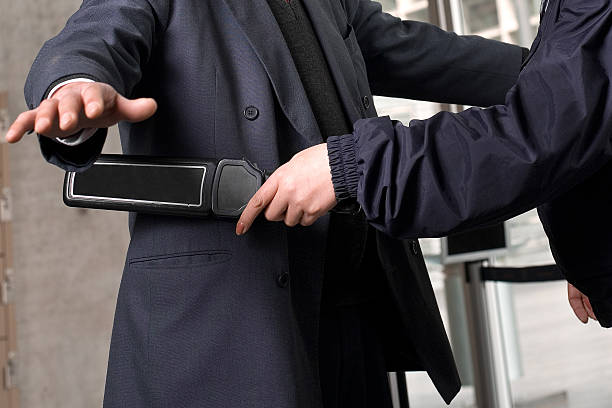
Searching premises – pre-entry premises checks
It is the responsibility of the Security Operatives to check that all reasonable measures have been taken to make sure the premises are safe and there may be a checklist to help you carry this out. This may include checking that:
- exit doors are unlocked and can be used during business hours
- chains, padlocks or other fastenings have been removed where access is required
- panic bolts and latches should be checked to ensure they can be opened easily
- there are no obstructions, such as parked cars outside the doors or rubbish inside or outside exit doors
- escape routes are not reduced by furniture or rubbish
- any fire hazard, such as waste paper or litter, is removed
- any health and safety hazards are reported immediately or death with where possible
- all fire exits signs are lit and clearly visable, for example, not obstructed by curtains or posters.
- Fire doors must be kept closed as the purpose of a fire door is to make sure that fire is contained behind the door while customers and staff escape. Fire doors stop smoke and flames from spreading into escape routes and other parts of the building. Most fire doors are self-closing, but if a fire door has to be kept open during operations, devices can be used to close it if there is a fire. In every case where there is such a device, the local authority must agree to it. If you are responsible for checking fire doors in your premises, you must find out from the manager whether any open door has this local authority permission.
- Fire-fighting equipment, such as fire extinguishers and hose reels, must be in the positions stated by the fire authority and must be ready to use. They must be placed on their brackets. They should never be used to prop open doors. Unless you are a trained fire-fighter, you should not try to tackle even small fires.
- Emergency lighting – Emergency exits must be well lit and checks should be made to ensure that exit routes, stairways and fire signs are properly lit. Exit signs must always be clearly visible.
- In most premises there is an emergency battery-operated lighting system. This will automatically activate if the mains lighting fails. This system must be checked to make sure it is in working order before the premises open.
- Public address/fire alarm systems – All public address systems and/or fire alarms must be checked and in working order. The legal requirement is a test every 7 days.
- All emergency exit routes must be free of obstructions so that people can leave the premises quickly and easily in an emergency. This cannot take place if emergency exit doors are locked or if exit routes are blocked. Emergency exit doors usually open in the direction of the escape and can therefore be kept closed. They must be left unlocked. Inward opening doors should be kept open so that they can be used easily in an emergency.
Searching people
Why carry out searches?
Searching ensures safety. Visitors, employees, bag and vehicle searches may be carried out to ensure that no weapons, drugs or other items are brought on site which could:
- put staff and other customers in danger
- make the management liable to prosecution.
You may need to search people before you allow them into your premises. You may also have to search people after they have been admitted to the premises. You therefore need to know your premises’ procedure for searching people before and after admission.
Types of search
There are three main types of search:
- a general search, when you will be required to search all people entering site
- a random search, when people to be searched are selected at random so, for example, 1 in every 10 customers may be searched (selection is usually made by some type of electronic system)
- a specific search, when particular individuals, for example a hostile ex-employee, will be searched. In this case selection cannot discriminate on the grounds of race, colour, sex or disability.
Pre-search procedures
Warn the individual
- the management of the premises can choose to search people as they come into the premises, and it is good practice to display a notice showing the premises’ search policy at the entrance.
- Individuals should be warned that searches could happen and also warned before they are searched. Individuals who do not agree to be searched should be refused entry. If a search is requested after an individual has been admitted to the premises, but they refuse to be searched then you may have to escort them off site or detain them until the authorities arrive if a crime may have occurred, i.e. theft.
Get permission
You have no legal power to search anyone so you must ask permission to search. If you search someone without their permission, this could result in:
- criminal proceedings against you for assault (criminal law is concerned with acts which are against the law and punishable by law)
- civil action for compensation against you or the management (civil law is concerned with private rights).
Carrying out a search
When you search someone, you must:
- be polite
- be tactful
- be positive and ready to ask and answer questions
- be professional: firm but fair
- be respectful.
Standard search procedures should include these rules:
- get permission (see above)
- make sure you have a witness present
- if possible, conduct searches where the search will be recorded on CCTV
- when searching bags, ask the owner of the bag to remove the items for you to see. You should not touch the contents of the bag
- men must be searched by men; women must be searched by women.
- search the individual from the sides – not directly from the front
- make sure you can see the person’s hands and that they are open and away from pockets
- keep a balanced stance and watch the person’s movements
- use questions to establish what they are carrying
- ask questions rather than force your hands into pockets where there might be syringes or needles
- never ask an individual to strip or remove clothing close to the skin.
What to look for when searching customers
When searching customers, you should look for:
- drugs
- offensive weapons
- unauthorised items such as company asse
What is an offensive weapon?
Offensive weapons are any objects that are made, adapted or used to cause injury, for example:
- coshes, knuckle dusters, telescopic truncheons or firearms (including replica firearms)
- items adapted to injure, for example, toothbrushes with razor blades attached to them
- any object used to cause injury to someone, for example, a barstool or bottle or any pressurised canister including deodorants, body sprays etc.
Generally, carrying an offensive weapon in a public place is an indictable offence. It is also an offence to carry a bladed or pointed article that could be used to injure someone (An exception is a folding knife with a blade under 3 inches long). Carrying a weapon in case someone else attacks you with a weapon is also illegal. The penalty for carrying an offensive weapon in a public place is up to four years imprisonment.
What are the hazards of searching?
The main hazard when searching is risk of injury from sharp objects such as blades and needles from syringes. The hazard is not only the injury itself (a cut or needle stick) but also the risk of infection with viruses such as HIV and hepatitis. In order to protect yourself you may need to wear rubber or needle-proof gloves when carrying out searches
What should you do if drugs or weapons are found during a search?
You need to know the law and the management’s policy on:
- which items you should seize
- what to do when you find such items and what you should do with them.
Make sure the local police agree with the procedure. You should keep a written record of the search or find, which states:
- how the item was seized
- why it was seized
- when it was seized.
Drugs
If suspicious substances are found, the following action should be taken:
- a member of the management team should be called to the scene immediately
- show the management representative what has been found before anything is moved
- the door supervisor who found the drugs and management member should take the drugs to a secure office
- drugs in tablet form should be counted and placed in a plastic bag (using surgical gloves, if possible)
- the plastic bag should be sealed using a tamper-proof seal (preferably numbered), and labelled to show the contents and the date
- if tags and seals are not available, an envelope can be used. It should be sealed and signed across the sealing flap
- the plastic bag or envelope should then be placed in a locked safe or other secure cabinet
- the police should be called and the drugs handed over against a receipt (check locally agreed procedures).
Your premises’ drug policy should ensure that the integrity, continuity and chain of custody of any seized items will withstand scrutiny at every stage of the process. There has to be protection to prevent any allegation that drugs went missing, or that the quantity found was increased or switched. If you are involved in pre-entry searches of your premises, you should always make sure you have a colleague with you. Details of any substances found should be recorded in the Duty Register by the person who found the substances.
If possible the pairings of those involved in searches should be varied so that you do not always work with the same person. This is to protect you from any possible allegation of malpractice.
Offensive Weapons
You need to know your premises’ policy on offensive weapons, but here are two examples:
- Policy 1 – Seize the weapon; refuse entry to the person; follow the premises’ procedure for securing the weapon; record the incident.
- Policy 2 – Seize the weapon; arrest the person; call the police; hand the weapon and customer over to the police; record the incident. You should never hold on to an offensive weapon even for a short time. Whilst it is in your possession you could be liable to prosecution.
Security Guards are not above the law and must never carry weapons or blades.
Monitoring Systems
Published By: BIIAB
Types of Security and Monitoring Systems
Many assignments will have different types of security and safety monitoring systems. It is likely to be the security officer’s responsibility to set and/or monitor these systems and it is therefore important to have an understanding of the different types.
Security Systems
Intruder alarm- These are used to detect the presence of intruders and are activated by different detection devices – e.g. movement detectors, door sensors, fence alarms etc
Access control- These are used to control entry, and exit to and from premises – this not only ensures authorised personnel have access to the site but can also be used for example to provide information for a role call in the event of a fire evacuation.
Safety Systems
Fire Alarm (fire and/or smoke) – These are used to detect the presence of fire or the start of a fire i.e. smoke and heat, to alert people or fire control systems to the fact that a fire has started.
Security and Safety systems
Closed Circuit Television Cameras (CCTV) – Typically used to monitor and record events at premises or other locations such as shopping centres or entrance and exits to secure sites. They are also used to maintain surveillance on vulnerable people and areas for example the security officer patrolling a fence line
There are different types of camera for different situations: fixed cameras, cameras which will pan, tilt and zoom (PTZ) and dome cameras which may allow 360°coverage.
It is the security officer’s responsibility on many assignments to set and/or monitor these systems. In some cases this may consist of a small, stand alone system, which has only a very few detection devices.
Other systems may be very large, involving numerous detection devices of different types which are linked to each other, known as ‘integrated systems’
The Functions of Electronic Security Systems
All systems will carry out three functions, which are:
- Detection – identify a change of state
- Control – how the change of state is monitored and how the system reacts
- Action – what the system does in response.
Detection
Intruder alarm
Modern detection devices are very sophisticated and use various types of technology to suit the environment and activity in the area they are required to protect.
They are designed to detect the intrusion of people or objects into buildings enclosed premises or an outside area. Detection is achieved in a number of ways by many differing types of detector – examples of just a few of these include:
- Passive infrared (PIR) detectors; these are widely used space protectors which are activated by changes in temperature e.g. by human body heat, accompanied by movement
- Vibration sensors or break glass detectors on or close to windows/glass panes
-
Magnetic door and window contacts, activated by opening/breaking an electrical circuit.
Close Circuit Television
CCTV cameras can be programmed in a number of ways. They may be permanently ‘on’, and are capable of recording all the time, at selected times, or upon command.
They can be, and often are linked to other features of the security system and can for example, be activated by another detection device such as a PIR detector allowing the CCTV system to monitor/record activity in the relevant area.
The main purpose of CCTV systems is to monitor and record events and to maintain surveillance of vulnerable areas or people.
Access control
Detection of correct information by keypads/card readers/biometric detection.
Access control systems rely on authorised persons inputting or possessing certain credentials:
- Something they know- Pin number, password etc
- Something they have- Swipe card/key fobs/proximity card
- Something they are- Biometrics (unique to them physically, finger prints, palm prints, or iris)
Examples of detectors used in access control are such things as keypads and card-readers.
- Keypad - A number or password is entered into an electronic keypad
- Card reader – A card/key fob is either ‘swiped’ through, or presented to a card reader at the point of entry
-
Biometric Access Control – An electronic scanner matching details against supplied data from authorised persons e.g. palm or finger prints/eye (iris)
Fire detection equipment
These detectors are sensitive to heat, flames, smoke and in some instances gas (e.g. carbon monoxide) and when activated the equipment informs the fire control system. They detect the early signs of fire and alert security staff to this.
If a fire is discovered on patrol the security officer can inform the fire control system by using a ‘manual call point’ (MCP) - either break glass, or push button operation - and so it is essential the security officer is familiar with the location of these manual call points (MCP)
Control
Control systems communicate with detection devices and alarm devices. The control function consists of:
- How the electronic security system monitors the information it receives from detectors and
- How it reacts to information it receives from detectors.
Intruder alarm
Intruder alarms have a control panel which ‘decides’, from the information received if an alarm condition is warranted. It then instructs the system how to respond.
The person monitoring the system (very often a security officer) is alerted by the control panel receiving a signal which is either displayed on the control panel as an illuminated light or activates a low level audible warning alarm system.
After an ‘activation’, the control panel will display which areas of the site have been attacked. The assignment instructions or a specific guidance manual will assist in this identification and enable ‘response forces’ to be directed to attend and investigate the attacked area.
In addition to the low volume audible warning on the control panel, a loud audible warning alarm, usually a siren or a bell, will also activate. This will act as a deterrent, warning would be attackers/intruders that response forces are in attendance and encourage them to leave.
CCTV
CCTV cameras can be directed automatically by the activation of detectors to provide camera coverage in the affected area. They are usually linked to recording equipment which records permanently or is activated ‘on command’ by the system.
Where the CCTV is monitored by a control room or central monitoring station the operator is able to view the camera images and respond accordingly.
Access control
It does what it says! – The system ‘decides’ from the receipt of correct or incorrect information presented by an individual (codes/swipe card etc) whether to allow or deny access.
Fire alarm
Controlled by the information it receives from the fire detection equipment, including activation of a manual call point (MCP).
What Happens Next?
After the electronic security system has detected (intruder/fire/access etc) and passed this information to the control, the final stage is what ‘action’ the system takes.
This action is in many different forms dependant on the type of system and may include some or all of the following:
Intruder alarm - Action
Action at alarm location:
- Audible warnings, internal external sounders – alarm bells, buzzers, sirens, voice broadcast, switching on of floodlights etc
Remote action:
- Automated call to a control room or alarm central monitoring station activating lights/sounds on the display panel to alert the operator.
Recording equipment may be activated which includes:
CCTV - Action
If they are not permanently monitoring an area cameras may be activated and commanded to cover the relevant area. Additional cameras may be activated e.g. fixed cameras may be switched on if not permanently monitoring, Pan, Tilt and Zoom (PTZ) cameras may be directed to cover the affected zone or to ‘zoom in’ to a specific area. Additional lighting may be switched on to enhance image quality and detail. Recording devices, if not permanently recording images may be activated.
Access control – Action
The action is very straightforward – The system either allows access or denies access.
Fire detection – Action
The action by the security system is based on the information provided by the control and will include:
- Evacuation Sounders – Sounders (bells/buzzers etc), voice messages – instructing people to leave the building/affected area
- Lights - flashing/strobe lights used for example in noisy areas
- Initiate a call to control room or monitoring centre to alert the operator
- Close down ventilation systems
- Release of extinguishers
-
Return of lifts to ground floors and prevent further use.
Alarm System Operator Controls and Indicators
Each security and emergency system has a set of controls and indicators. It is vital, if a security officer is to respond correctly, that they know what these controls and indicators are.
Fire Alarms
British standards specify that fire systems must indicate by both sight and sound when a fire or an indication of a fire has been detected. They must also indicate by sound and sight when a fault on the system has occurred.
The following controls are compulsory:
- Alarm Indication- Each Zone must have a red indicator which must light up if there is an alarm or activation in that Zone. A red light will have one meaning only – A fire alarm has been activated in that zone and must be responded to accordingly. In addition the system must have an audible indication that an alarm has been activated and this must be different from the audible alarm indication.
- Fault Indication- Each Zone must have a yellow or amber indicator which must light up if there is an alarm or activation in that Zone. A yellow light will mean that there has been an occurrence which must be reported and investigated.
- In addition, the system must have an audible indication that an alarm has activated and this must be different from the audible alarm indication
- Mute Switches – Separate switches which silence the alarm or fault indicator.
- Reset Switch – This switch is the only way a security officer can reset an alarm. The operator should ensure the condition which caused the alarm is no longer present as the alarm will sound again when the reset switch is used.
- Disable/Inhibit switch - This switch is used to disable part of a system and is normally used to carry out maintenance work. Again there will be an audible and visual indication that part of the system is disabled and these indicators must be different to the alarm and fault indicators.
Actions to Take in Response to Alarm Activations
A security officer monitoring alarm signals must clearly be able to identify the different sounds and indicator lights made by different types of alarm. With this knowledge a prompt and appropriate response can be initiated to an alarm activation.
Stages of a Response
Initial Response
Response is immediate - this may be an emergency situation. The first thing needed is information and the security officer needs to know where that information can be found.
For example:
- Inspect the control panel to establish the location and nature of the incident
- Assignment instructions will give information about emergency procedures
Secondary Response
Examples include:
- Calling emergency services
- Organisation of evacuation
- Deployment of resources
-
Investigation of intruder alarm activation.
Details of the alarm activation should be recorded and if necessary an incident log maintained. A full incident report may also be required.
All alarm activations should be treated as genuine calls until an investigation proves otherwise. Even if an alarm has a history of false activation, any activation should be treated as genuine and responded to accordingly.
False Alarms
A ‘false alarm’ is defined as ‘an alarm that causes the reaction forces to respond unnecessarily’.
In the security context, of protecting life and property the ‘reaction forces’ are normally the security officer, the emergency services or owners of the property.
Problems caused by false alarms
False alarms are a major concern and can cause problems in a number of ways:
• Complacency – numerous false alarms can create complacency within the ‘reactionary force’ - A ‘cry wolf’ situation can develop with the danger that if a genuine alarm occurs the response will be poor
- Noise – audible alarms are a warning and deterrent. If however, they regularly activate both these benefits are reduced, and they become a noise nuisance
- Expense – incurred in responding, and also by the interruption to business/loss of production etc
-
Police response – police policy is that under certain circumstances, where an alarm has a history of false calls police response to an activation will be withdrawn.
Causes of False Alarms
There are several causes of false alarms:
- User error – e.g. alarm not correctly set
- Environmental conditions – weather
- Incorrect Installation
- Defective equipment – the system.
Crime Prevention: Using Surveillance and CCTV

Published By: Night Time Industry Association

CCTV can help to reduce the risk of work-related violence and crime by:
The Importance of Reporting and Record Keeping

Published By: BIIAB
The Different Types of Records Relevant to a Security Officer
The Daily Occurrence Book (D.O.B.)
- During the course of the shift, all activities and incidents can be recorded in chronological order, in the Daily Occurrence Book.
- The Daily Occurrence Book/ Assignment Log can be used to record any special requests or instructions from the Client.
- The Daily Occurrence Book/ Assignment Log can be used to pass information to the in-coming shift, e.g. staff let on site, messages, etc.
- Copies of the Daily Occurrence Book remain on site.
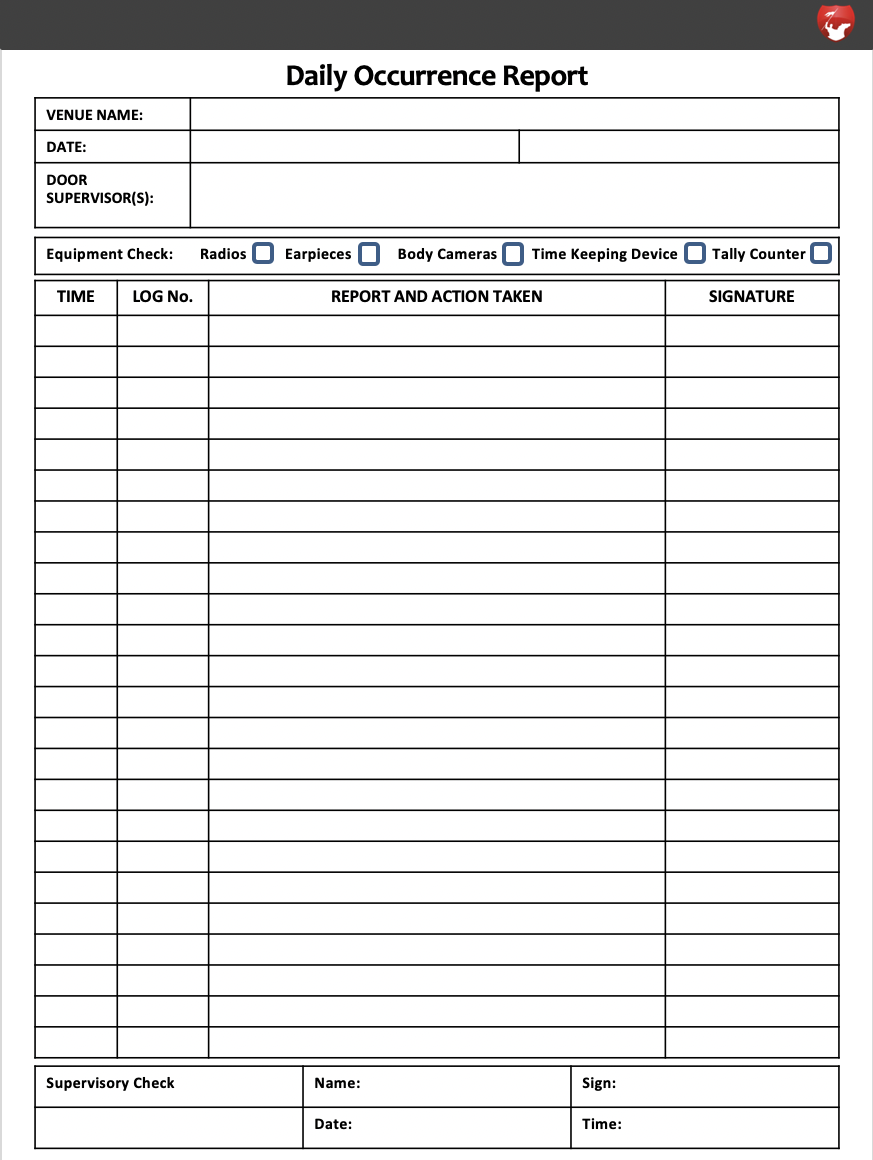
Incident Report Guide: All You Need To Know
Published on: 26 May 2023 By: SafetyCulture
Incident Report
Fire Safety – What Security Professionals Need To Know
Published By: Get Licensed
Awareness & Responsibility
Fire is a devastating occurrence for life and property. Two of the things that security personnel are charged with protecting. Awareness of fire risk and the actions to take are the responsibility of each security operator. The 6-day training course for your SIA door supervisors licence will involve fire awareness training.
Your responsibility is to maintain that awareness and training. This will enable you to act calmly and efficiently in the event of a fire.
Reasons For Being Trained In Fire Safety
It is not just the flames that are dangerous in a fire.
- Smoke inhalation is the most common cause of death in a fire.
- Becoming overcome by the heat.
- Lack of oxygen as the fire burns up all the oxygen present.
- Risk of physical injury as fire-damaged structure starts to fall.
- Not having an escape route due to it being blocked or not able to open an exit.
Understanding Fire
Fire is where fuel + oxygen + heat combines, creating a fire triangle. Remove one of the elements, and you won’t have a fire. The same goes for a fire tetrahedron, where you have a fourth element of chemical reactions. By removing one of the elements, you will put out the fire. Fire extinguishers play an essential role in removing a component to control fire.
Fire Prevention
It is imperative you learn the simple measures you can take in preventing fires on your watch. Things like
- Making sure fire exits are clear and can easily be accessed.
- Keeping the workplace tidy – or taking note when it isn’t and inform the relevant manager.
- Effective management of waste – know what is flammable
- Knowing how to reduce the risk of electrical fires occurring.
- Know where the fire exits are and how they open.
- Be aware if staff or customers don’t respect the need to keep them clear of obstruction.
- If any item of equipment is found to be damaged or deficient, it should be reported to Management immediately.
Be alert for telltale signs of a fire:
- Smell
- Noise
- Smoke
- Flames
Learn the location of fire alarms and fire extinguishers. Ensure that exit signs are visible, Be aware of any other fire precautions in a building like water sprinklers and fire hoses.
Fire Extinguishers & Their Uses
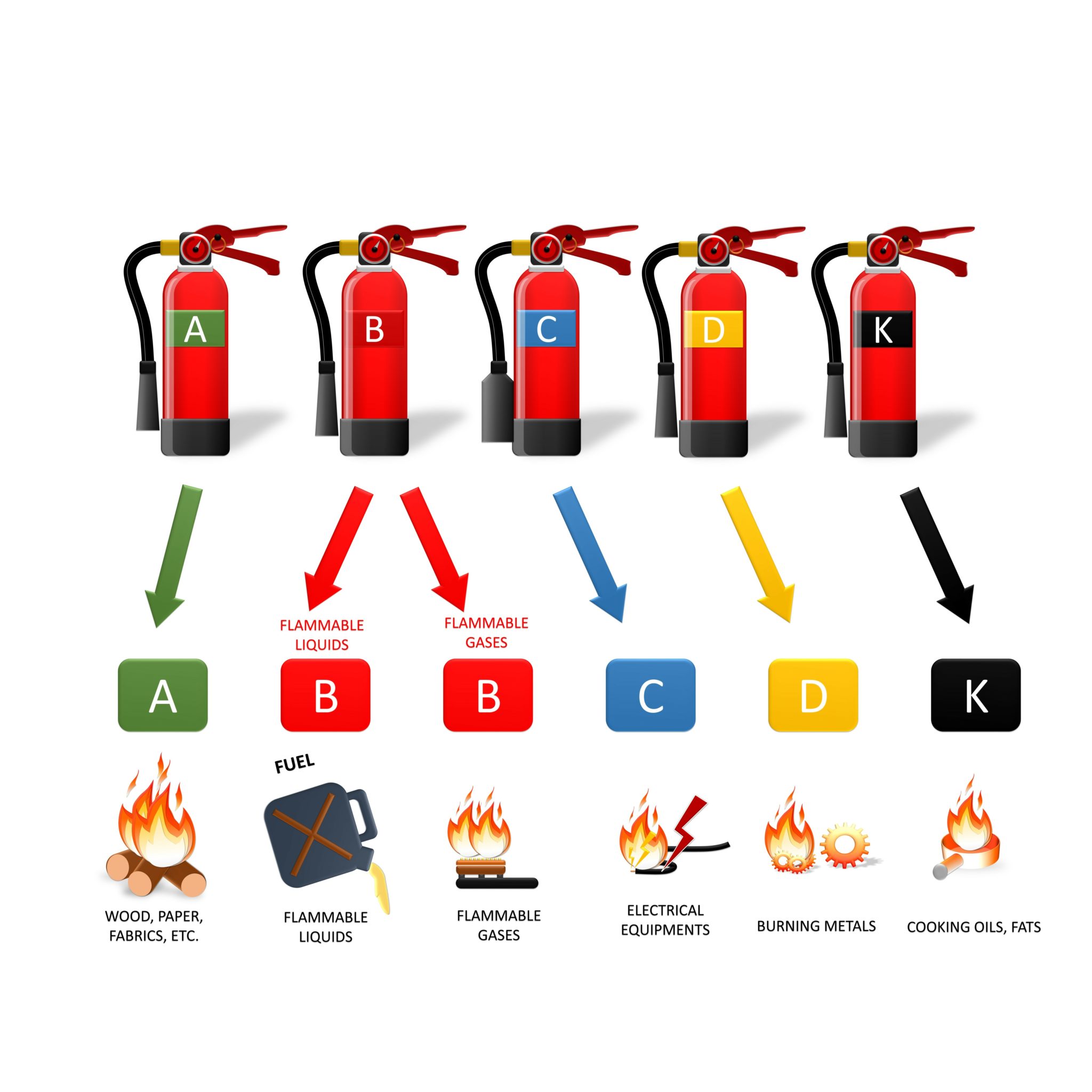
Six Categories Of Fire
Class A fires – fueled by combustible materials—including wood, paper, and textiles
Class B fires – fueled by flammable liquids—such as paint, petrol or spirits
Class C fires – fueled by combustible gases—including propane and butane
Class D fires – fueled by volatile metals—chemicals such as potassium, magnesium or lithium
Electrical fires – fueled by electrical equipment—computers and photocopiers etc. Removing the electrical component changes the fire’s class.
Class F fires – fueled by cooking oils—chip-pan fire or olive oil or butter.
It is crucial to have the correct extinguisher for the area. Fire extinguishers are designed to tackle particular fuels.
Fire Extinguishers – Water
One of the most common fire extinguishers, these release water under high pressure. They are for Class A fires.
Do not use a water fire extinguisher for:
- Kitchen fires
- Fires involving electronic equipment
- Fires caused by flammable liquids or gas.
Fire Extinguishers – Foam
These extinguishers are for Class B and Class A fires. The foam creates a barrier between the fuel and the oxygen.
Do not use a foam fire extinguisher for;
- Kitchen fires
- Fires involving electronic equipment
- Fires caused by flammable liquids or gas.
Fire Extinguishers – Dry Powder
These extinguishers are for Class A, B & C fires and fires that involve electrical equipment up to 1,000v. There are also specialist dry powder extinguishers for flammable metal fires, like titanium. It would be best to avoid using dry powder extinguishers in an enclosed space to prevent inhaling the powder.
Do not use a dry powder fire extinguisher for:
- Fires involving electronic equipment over 1000v
- Kitchen fires involving cooking oil
- Fires raging in enclosed spaces.
Fire Extinguishers – Carbon Dioxide ( CO2)
These extinguishers are the primary option for electrical fires and Class B fires. They are found mainly in business with a high electrical equipment component like server rooms and tech stores—these work by suffocating the fire, removing the oxygen element, which lets the fire die out.
Do not use a CO2 fire extinguisher for:
- Fires involving flammable metals
- Kitchen fires
- Fires involving materials like paper or textiles.
Fire Extinguishers – Wet Chemical
These extinguishers are for Class F fires, with cooking oil, so found in places with kitchens, restaurants, hotels, cafes, chippies, etc. These are also usable for Class A fires—but a foam or water extinguisher would be a better option. They work by starving the fuel of oxygen by creating a foam layer on top of the burning oil. The fine mist it produces when activated is potassium. Potassium reacts to the oil, making a foamy or soapy film. This also acts as a coolant.
Do not use a CO2 fire extinguisher for:
- Fires involving flammable liquids or gasses
- Electrical fires
- Fires involving flammable metals
A risk assessment will decide which extinguishers are necessary for a building and where. As a licensed security officer, it is your responsibility to familiarise yourself with where they are —the same goes for fire hoses—and how to operate them.
Like with all aspects of security work, you need to stay sharp and stay calm. Implement the emergency procedures for the building you are in. If there are no such procedures, then be proactive and ask what your role would be in the event of a fire.
Calling 999 | Fire
Published By: London Fire Brigade

Test Your Basic Fire Safety Knowledge
The National Counter Terrorism Security Office (NaCTSO) has refreshed their 'Crowded Places Guidance' to help people respond safely to incidents involving hazardous substances – prompting people to act quickly, which can save lives.
The 'REMOVE, REMOVE, REMOVE' procedure has now been added to the Chemical, Biological and Radiological (CBR) Attacks section and is designed to support first responders.
READ MORE:
- National Counter Terrorism Security Office (NaCTSO)
- Crowded Places Guidance
- Acid Attacks NHS guidance
Medical Emergencies
As part of the SIA Licence training, it is now a requirement for a door supervisor to complete a first aid qualification before taking their licence-linked training. So use your training, skills and own judgement when dealing with medical emergencies. However, we've included some links to resources that may help you refresh your knowledge.
HSE | Basic Advise on first aid at work
NHS | When to call 999
British Red Cross | First Aid
St Johns Ambulance | First Aid Advice

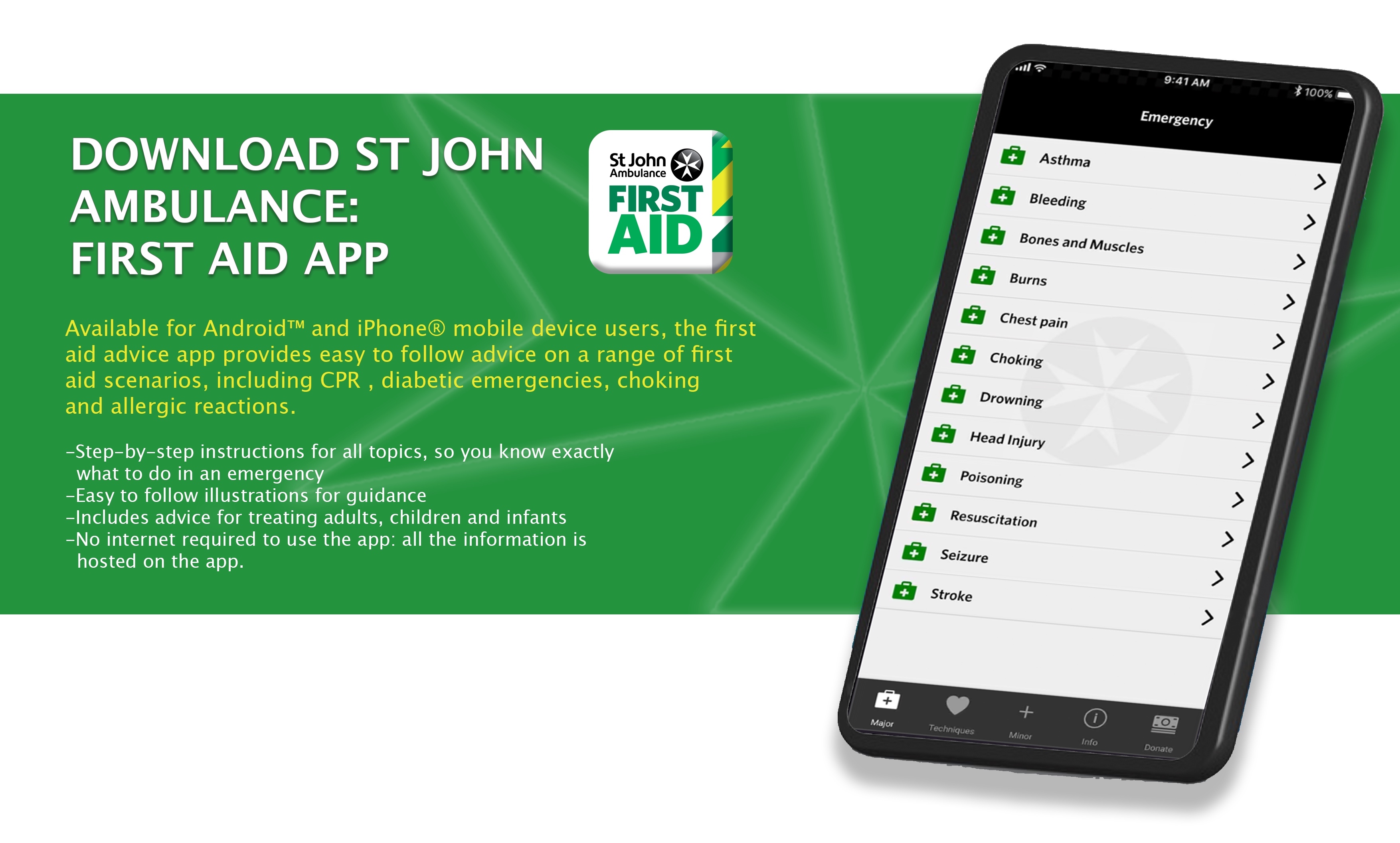
Protect UK | Bomb threat Guidance
Published By: Protect UK

National threat level
The threat to the UK (England, Wales, Scotland and Northern Ireland) from terrorism is:
SUBSTANTIAL

The current UK threat level for terrorism can be located on the gov.uk website’ www.gov.uk/terrorism-national-emergency
Bomb Threat Checklist
We have provided our Bomb Threat Checklist/Guidance Form below for your use, however, there are other checklist online that can be used.
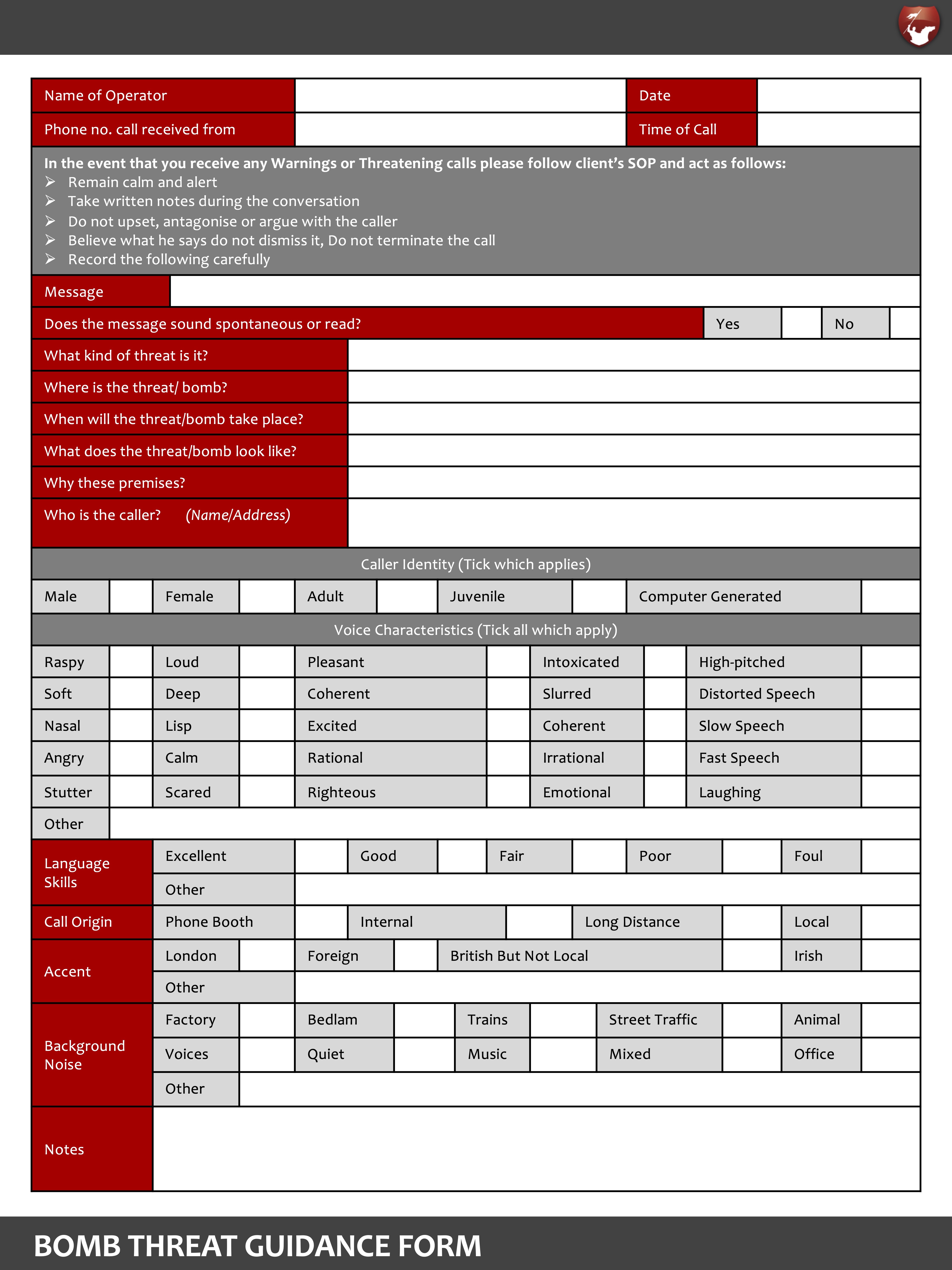

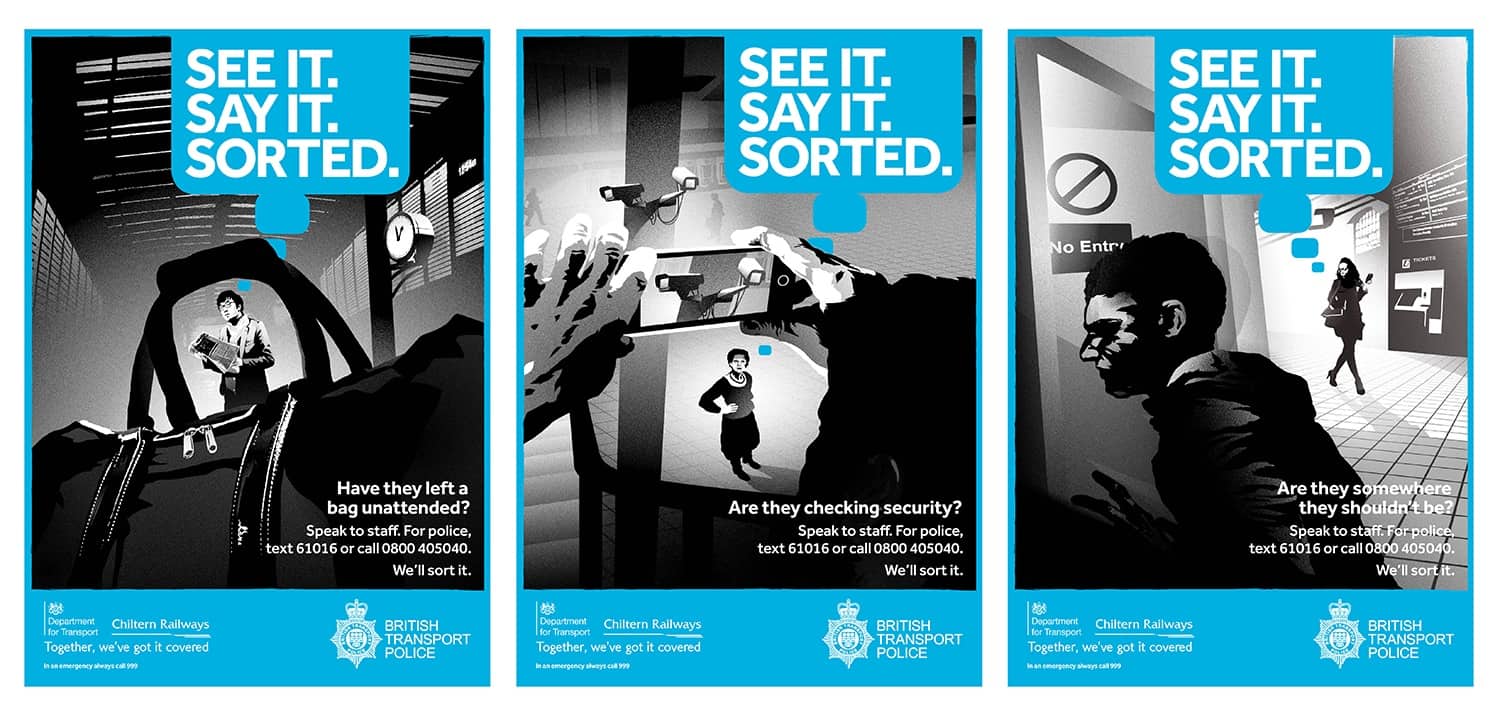
How to Protect Yourself and Others: Guidance for Security Operatives
A job in Security can be difficult; dealing with members of the public in challenging circumstances and often placing yourselves in harm’s way. The SIA (Security Industry Authority) have provided some guidance on good practice to help you continue to protect the public and keep yourself safe.
Helping Vulnerable People
When working in the night-time economy you have an important role to identify and support people who may be vulnerable.
Look out for signs of vulnerable individuals, who might be:
- under the influence of alcohol or drugs
- alone or receiving unwanted attention
- separated from friends
- lost or isolated
- being followed or threatened
- victims of child exploitation
- under the age of 18
- elderly
- with mental ill-health
- with learning, physical, or a range of invisible disabilities

If you are concerned about someone’s ability to get home safely, please consider the following:
- seek the help of street pastors, street marshals or any other active schemes
- call a relative to help in the case of a younger or vulnerable adult
- get a taxi or private hire vehicle for the person concerned (private hire vehicles must be booked through a licensed operator by phone, app or at a booking office; taxis can be hired the same way or hailed in the street or at a taxi rank)
- use ‘safe havens’ or other local initiatives run by organisations such as St John’s Ambulance
- call the police
Signs of a Drug Overdose

Published By: withyou
Physical Intervention to Avoid
You should only use physical intervention as a last resort and never use more force than is necessary.
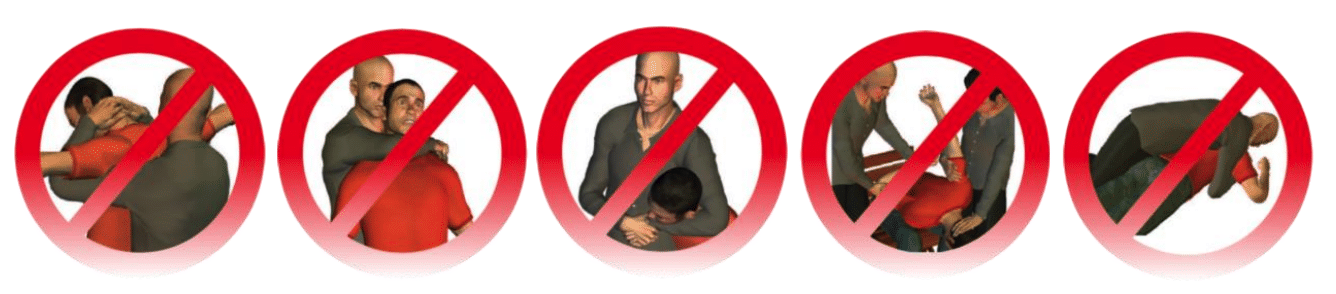
- Avoid high risk methods of restraint, such as neck holds and other holds that can damage the spine and adversely affect breathing or circulation
- Positional asphyxia typically occurs during forceful restraint involving weight or pressure on the torso
- Avoid high risk positions including ground restraints
Use of Force
I agree that any force I use will only be used as a last resort and only when alternatives have failed. I agree that I will use good communication and conflict management skills to resolve potential violent situationsI understand that I must account for any use of force, and that any force I do use must be reasonable, necessary and proportionate in the circumstances. I confirm that I understand how and when to record incidents and near misses and informed of the location of the incident report book to record incidents I have witnessed or been involved in. I am aware of locations of the preferred ejection routes and that this is due to CCTV coverage in these areas which will protect my reputation and reassure the ejected customer. I have been informed of which restraint techniques are to be avoided as illustrated above and I agree to avoid their use. I have been informed of the codes used for communication i.e. in the event of a fire, fight, drugs or assistance required. I have been assessed and deemed competent in basic skills for radio communication. I can confirm my awareness of the process of signing in & out, and the re-charging of radios and reporting faulty radios to the HDI can confirm I have read and understand the physical intervention guidance provided in this assignment manual.
I will use my own skill, experience and judgement in providing these services
Positional (or restraint) asphyxia – what is it?

Positional asphyxia occurs mostly during ground restraints, although can also occur in other positions. This is where a person is held forcefully, face down or face up, on the floor. Many people have died as a result of positional asphyxia during forceful restraint. Others have suffered permanent brain damage linked to oxygen deprivation. You should avoid restraints that carry a heightened risk of positional asphyxia.
What can cause positional asphyxia?
Method of restraint: Positional asphyxia typically occurs during forceful restraint involving weight or pressure on the torso. All forceful restraints on the ground carry heightened risk.
Position: Forceful holds in certain positions increase risks of positional asphyxia. These positions include face up or face down restraint, either on the ground or another surface such as a bed or bar/counter. Also seated or standing positions where breathing and/or circulation are compromised e.g. by being bent forward.
Duration: The longer a person is held in a position and/or by a method carrying heightened risk of positional asphyxia, the longer their exposure to risk and subsequently potential for harm and death.
Follow your emergency procedures and training which can include:
- Immediately cease the restraint (if restraint was being applied)
- Check Airway – Breathing – Circulation (A-B-C)
- Place in the recovery position
- Call appropriate emergency services
- Commence CPR/defibrillator if necessary
- Provide emergency services with a briefing that includes anything known about the person affected that may help their assessment and treatment. Include details of any restraint including the method, position and duration.
Act on ‘red flags’ during or following a restraint
- Effort with breathing
- Blocked airway and/or vomiting
- Passivity or reduced consciousness
- Individual being non responsive
- Signs of head or spinal injury
- Facial swelling
- Evidence of alcohol or drug overdose Blueness around lips, face or nails
- Individual held complaining of difficulty breathing
- High body temperature, profuse sweating/hot skin
- Exhaustion
- Confusion, disorientation and incoherence
- Hallucinations, delusions, mania, paranoia
- Bizarre behaviour
- Extreme fear
- High resistance and abnormal strength
Safety Culture Survey
We feel the incidents of abuse security personnel are subjected to occur happen too frequently and all of us are guilty of accepting this as part and parcel of the job.
We have crated a survey to get your opinions on the Safety Culture in Security and want to here your views. You can complete the survey at: Safety Culture Survey
The relevant results of this survey will be shared with IPSA International Professional Security Association to raise awareness within governing bodies.
SIA Training Video
Door supervisors play a vital role in keeping the public safe - especially if you’re working in clubs and bars during busy periods. Please watch this SIA video with reminders of your training in ways to spot and help people in vulnerable situations. Your skills can help protect the public from predatory behaviour, spiking, and sexual assault.
Video Link: www.youtube.com/watch?v=5dEv2Cz7MKk
Overdose Factsheets
The International Overdose Awareness Campaign have provided factsheets, that you can download on the following overdose types:

You should only use physical intervention as a last resort
Physical intervention can:
- Increase risks of harm to staff and customers
- Result in prosecution if use of force was unnecessary, excessive, or in any way unlawful
- Lead to allegations against staff and potentially loss of licence and/or work.
Examples of a ‘last resort’ situation include:
- Where necessary to prevent harm
- When other options have failed, or are likely to fail
- When it is not possible or appropriate to withdraw
Alternatives to Physical Intervention
Primary Controls:
- Use your training
- Follow the client’s safety and security policies, procedures and working practices
- Use of safety and security equipment (e.g. radio for summoning assistance, CCTV)
- Being positive and proactive in service delivery
Secondary Controls:
- Positive and effective interpersonal communication and the knowledge and skills of conflict management to de-escalate conflict situations and reduce the need for physical intervention
Your responsibility during physical intervention
- Use the least forceful option
- Maintain duty of care to the subject following restraint
- Respect the dignity of people being restrained wherever possible
- Provide appropriate medical attention to any person who appears to be injured or at risk
- Challenge unnecessary and excessive use of force by colleagues
- All staff involved in a physical intervention have a responsibility to ensure the safety of everyone involved
- Where more than one member of staff is involved in a physical intervention, one of them should take charge of the intervention
Your responsibility immediately after a physical intervention
- De-escalate a restraint at the earliest opportunity
- Maintain duty of care to the subject following use of force/restraint
- Provide appropriate medical attention to any person who appears to be injured or at risk
- Preserve evidence and secure witnesses
- Staff involved must fully report and account individually for their actions
- Tell the emergency services (if present) about the circumstances, position, duration and any difficulties experienced in a restraint event
Reducing the risks of physical intervention
- Choose the least forceful intervention practicable
- Avoid high risk positions including ground restraints
- Avoid high risk methods of restraint, e.g. neck holds
- Keep up communication between staff and the subject during and following restraint
- Monitor the wellbeing of the subject of intervention for adverse reactions
- Ensure that leadership and teamwork happens, e.g. someone taking a lead role while others support
- Ensure practice follows the procedures taught
- De-escalate physical intervention at the earliest opportunity
- Immediately release and assist subject if they complains/demonstrates signs of breathlessness or other adverse reactions
- Record and report restraints in line with a venue's procedures
The Importance of Knowing the Law

Published By: BIIAB

Other Useful Resources
SIA Licensing Criteria | July 2022
SCaN for all staff- Highfield Learning Module
Staying Safe Online: Top Tips for Staff E learning
GOV.UK CT Awareness- Helpful Advice
ACT Report Suspicious Activity
NPSA- Marauding Terrorist Attacks
St Johns Ambulance- How to do a Primary Survey
Mental Health Awareness at Work E-learning
BIIAB | Level 2 Award in Security Guarding
 Leisuresec