
Published By: BIIAB
The Different Types of Records Relevant to a Security Officer
Security officers are required to complete various different reports and registers on a site. They may be handwritten or in some cases, computer based, and will include all or some of the following:
-
Assignment Instructions - a reference manual containing information which is needed for security officers to carry out their duties effectively. They form part of the contract between the Customer and the Security Company, showing the customer’s requirements
-
Accident Book – Used to record details of any accidents on site
-
Daily Occurrence Book (Site Log Book) – Used to record brief details of occurrences/activity on site
-
Duty Sheets – Security officers’ duty rotas
-
Handover Records – Records to show handover procedures have been carried out correctly
-
Incident Reports – Comprehensive reports of incidents/unusual occurrences
-
Key Register - Used control access to keys by signing them in and out
-
Patrol Log – Details all patrol timings
-
Pocket Books – Carried by security officers to make routine entries and contemporaneous notes of any incident etc
-
Search Register – Register of vehicles/people searched
-
Visitors Book – Register of visitors entering and leaving site
The Do’s and Don’ts of Report Writing
Routine activities which are a daily or regular occurrence, such as shift handovers, issue and receipt of keys, arrival and departure of staff, visitors etc are normally recorded in the appropriate book/register specific to that purpose.
Where a situation of a serious or unusual nature occurs a detailed and accurate report will be required. For this an incident report will be completed.
DO:
-
Only use black pen
-
Ensure your report is legible and understandable
-
Use clear, simple English and, if necessary, print them out
-
Plan what to say before starting
-
Record the information as soon as practicable
-
Sign and date all entries
-
Correct all errors by crossing out using a single line and initial the alteration
DO NOT:
-
Use jargon or abbreviations
-
Use pencil as it smudges and can be altered
-
Use correcting fluids
-
Tear or remove pages from book or register etc
Remember that reports can include diagrams as well as words if this helps to describe a situation.
Key considerations
When writing a report, remember that in the future you may be questioned on its content, It could for instance become evidence in court. It is wise to take a few moments to plan the content of the report and how you will structure it. This will help to ensure you include all relevant detail in such a way that is easy for the reader to understand.
A ‘well tried’ guide to the structure and content of a report which will ensure incidents or situations are recorded correctly is to address the following within the report.
The six points to cover are:
-
1 WHO?.........was involved
-
2 WHAT?........happened
-
3 WHERE?.....did it happen
-
4 WHEN?.......did it happen
-
5 WHY?..........did it happen
-
6 HOW?..........did it happen
The Importance of an Incident Report
The nature of a security officer’s work is likely to lead to the records, of situations and incidents they become involved with, being required in the future.
An incident report is a detailed report required for a non-routine activity and might for example be needed for:
-
Internal auditing
-
Insurers
-
Trade Unions
-
Health and Safety records
-
The Police – where any criminal activity is involved and evidence is required for use in court
-
To provide continuity of evidence where images have been captured on CCTV.
They may not be needed for months after they have been written, when recollections of the event may start to fade.
A properly written incident report, written as soon as possible after the event, is therefore essential while events are still fresh in the mind. Its importance can be summarised as follows:
-
As a permanent record of an incident – it can protect a security officer, and the organisation, from suggestions that their recollection of events is inaccurate or that duties weren’t carried out correctly
-
Others can use it to assist in deciding a course of action – it may be used as evidence in court proceedings or health and safety enquiries
The Information to be Recorded in an Incident Report
As already discussed your assignment instructions will dictate that an incident report will invariably be needed when an unusual or serious situation occurs. Some examples of these situations requiring a report are:
-
Crime – criminal damage/theft/burglary
-
Suspicious incident or situation
-
Incidents involving members of the public e.g. trespassing on site
-
An accident causing injury or damage
-
Evacuation of premises for any reason
-
Breach of or non-compliance with health and safety requirements.
This list is not exhaustive and incident reports may be required for other events.
Incident reports should be factual. Opinions should not generally be included in the report and if they are it should be made very clear that it is an opinion only.
The Report
The content of your report should contain the following:
Beginning
-
Identify yourself
-
The date and time of the report
-
Identify the reports recipient(s).
Middle
-
Date and time of the event
-
Details of persons involved by name and/or description - did you know them?
-
Names of any witnesses
-
Where - The exact place where the event took place
- Complete details of what happened - this will include some or all of:
- What you were doing at the time?
- What did you do?
- What did you see?
- What did you say? - exact words
- What did other people do?
- What did other people say?- exact words
- What was the weather like – if relevant, it may be a factor e.g. visibility
- What happened then?
- Who did you tell? – colleague/supervisor/emergency services?
- When did they arrive? – if they attended!
- Why did it happen? – if you’re able to say
- How did the incident occur? – if you’re able to say
- Details of any force used and reasons why the force was necessary.
End
- Date and signature of person making the report.
Utilise pocket book entries made at the time of the event to assist in writing your report.
Use of Pocket Notebooks
A security officer’s notebook is an essential and important piece of equipment which should be carried at all times when on duty. It will contain confidential information and should be kept in a safe, secure place when not on duty. It is the document used to record your daily, routine activities and for recording full details of an incident or unusual event. These original notes should me made at the time of, or if not practical to do so, as soon as possible after an event.
There are rules which need to be followed when using your notebook.
DO:
-
Carry your notebook at all times when on duty
-
Use your notebook to record routine and unusual events
-
Make detailed notes at the time, or, if not practical to do so, as soon as possible after the event whilst still fresh in your memory
-
If someone says something, write it down in their words
-
Make entries in black ink or ballpoint pen
-
If a page is left blank in error draw a diagonal line straight across the page and initial
-
If a correction is needed draw a single line through the word(s). Ensure it remains legible, and initial the alteration
-
Write on every line or draw a line through any part of a line not used and initial (to prevent any additions, or allegations that additions have been made at a later date)
-
Sign and date every entry in the book so that an entry can be used as evidence.
DO NOT:
-
Use the notebook for any personal reason – remember it could be required in court in the future
-
Tear out any pages
-
Erase any words
-
Overwrite or obliterate words making the original entry illegible
-
Leave blank spaces
-
Write between lines – this can indicate notes inserted afterwards.
A main reason for these rules is to ensure there can be no allegation or suspicion that an entry has been changed or added to.
The Content and Importance of a Hand-Over
At shift hand-over it is important, that all necessary information, documentation, and equipment are passed on to the incoming shift. This will ensure that security officers are properly briefed and equipped to maintain security.
Hand-Over Procedures
-
Allow sufficient time when reporting for duty to carry out a thorough handover
-
Incoming officer should read back through the daily occurrence book/incident report book to the last time they were on duty to be aware of any incidents, suspicious situations etc
-
Equipment – Discuss any deficiencies in equipment e.g. faulty radios, faulty alarms etc. Are there any outstanding keys? On-going deficiencies must be reported continually until repaired or no longer in action.
-
Discuss ongoing incidents, identifying any outstanding actions that are needed
-
Ensure all messages received during the shift have been dealt with, or passed on to be ‘actioned’
-
Documentation – All relevant documentation should be completed before going off duty
-
Finally, check all relevant keys and all other equipment are in the control of the incoming shift and not for instance left inadvertently in the pocket of an officer going off duty.
The NATO Phonetic Alphabet
The NATO (North Atlantic Treaty Organisation) phonetic alphabet was developed to assist in verbal communication being clearly understood, to ensure the message sent was the message received. This also reduces the necessity for messages to be repeated and keeps the air waves clear.
Messages should be:
A - Accurate
B - Brief
C - Clear
The alphabet uses an agreed word for each letter and if the sender and receiver are familiar with the alphabet, the chance of the listener confusing letters and getting the message wrong is vastly reduced.
We’ve all no doubt had to ask someone to repeat a spelling at some time or other. The letters P, B & D for instance can sound very similar, particularly if not spoken clearly or if they are passed by radio or telephone when reception is poor.
Using the phonetic alphabet these letters would be pronounced ‘P – Papa, B- Bravo, D- Delta’. They now each sound very different and can easily be distinguished from each other. The phonetic alphabet should be used in radio and telephone communications where necessary e.g. to spell names, give car registration numbers etc.
The Phonetic Alphabet
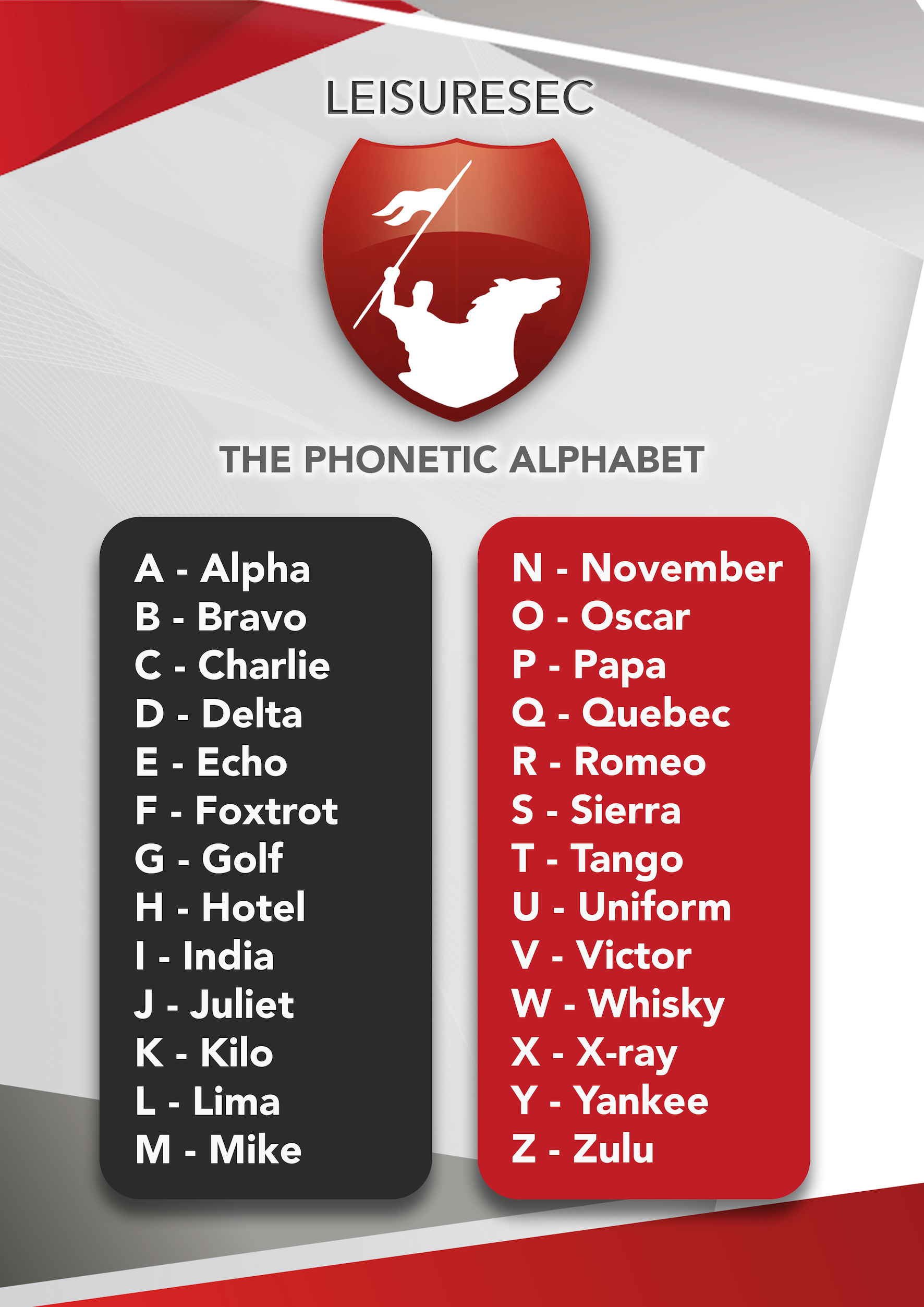
An operator using the phonetic alphabet to spell the word ‘security’, as an example would say ‘Sierra, Echo, Charlie, Uniform, Romeo, India, Tango, Yankee’
Similarly, to eliminate confusion there is also a recognised method for transmitting numbers. There are variations to this, but, in general, all numbers are communicated singularly; for example, to transmit the number 66 we would not say “sixty six”, but would say each letter separately; “Six, six”.
Therefore all numbers are an amalgamation of just the figures 0 to 9 and are pronounced more effectively using the following terminology:
0 = Zero
1 = Wun
2 = Too
3 = Thuree
4 = Fower
5 = Fife
6 = Six
7 = Seffern
8 = Ate
9 = Niner
In practice, it may aid transmission and understanding to use a combination of the two ways; so, in the example above, to transmit the number 66 you would say, “Six, Six. I say again. Sixty Six.”
Or a car registration Number e.g. AB 55 CEF becomes ‘Alpha, Bravo, Fife, Fife, Charlie, Echo, Foxtrot.’
- Log in to post comments
 Leisuresec